Our Klamath Basin Water Crisis
Upholding rural Americans' rights to grow food,
own property, and caretake our wildlife and natural resources.
Our Klamath Basin
Water Crisis
Upholding rural Americans' rights to grow food,
own property, and caretake our wildlife and natural resources.
http://www.rangemagazine.com/archives/stories/winter02/fightingforward.htm
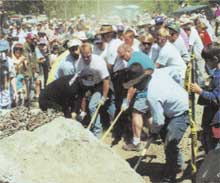
character seen not by defiance, but by unity in a purpose that still defines us all. Backs bent, dust swirling with sweat, hundreds of backs strained in concert to pull aside a monstrous boulder blocking the South Canyon Road near Jarbidge, Nev., the Fourth of July in 2000 (Range, Fall 2000). “Liberty,” they grunted in unison. “Freedom.” And in May 2001, neighbor by neighbor, stranger to newfound friend,
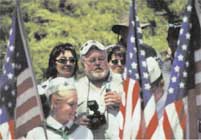
people who asked no more than to help. It was not the effort of an organized “cause” nearly as much as it seemed the work of what grew as an ever-larger family helping each other. Nowhere was there gunfire. Nowhere were there even arrests. But all over the West in the last two years, people did, at last as many said, fight back. Always behind that same flag. Always with the same meaning. Range will go back to Klamath this spring. We will watch to see that justice is restored to the farms of the Klamath Basin. We will drive up the South Canyon Road near Jarbidge, proud of who built it. We will see how it all works out in Owyhee and in the Mojave and in coastal California and along the Rio Grande, and in so many other places where people—families—still face being driven from their homes and from their productive livelihoods. It’s not over. And although our hearts will be with our nation as much, if not more so, than most Americans, the West will also know that at least from the success of bringing the simple honest truth to public attention in the last two years, more people now understand. More Americans recognize now that the strength of we the people is in the trust we have of each other and the ability we have together to face any challenge, foreign or domestic. We can all learn from what has happened, and we all have. The West will acknowledge that. We should only ask that those so willing or determined over recent years to sacrifice us and our way of life for some other future reconsider what the past has shown and what the present means to us all. We would hope to stand in that forest of flags together, if not always as friends, then always beyond that as fellow Americans.
|
Home
Page Updated: Thursday May 07, 2009 06:14 AM Pacific
Copyright © klamathbasincrisis.org, 2005, All Rights Reserved